

India tour of New Zealand 2026 · Fifth ODI preview

India lead the five-match ODI series 2–1, but New Zealand have brought it back to life. The hosts won the fourth ODI by 244 runs after bowling India out for just 89. The fifth and final match takes place at Bay Oval on Sunday, 15 November, at 7:30 AM IST. India need a win to finish 3–1; New Zealand need victory to draw the series 2–2.
There is a reason this final game feels much closer than the series score suggests. India won twice while rain affected the matches, but the first full 50-over contest at Mount Maunganui exposed their batting. New Zealand, meanwhile, must replace the two fast bowlers who did the most damage on Friday. The teams return to the same ground with very different questions to answer.
This NZ vs IND 5th ODI 2026 preview looks at the form behind the results, the personnel changes, the matchups that matter, and the winning chances for each side. The focus is on what could actually change on Sunday—not simply repeating the last scorecard.
Why the fifth ODI is a final showdown
India have already made sure they cannot lose the series. Even if New Zealand win the last match, the final score will be 2–2 because the third ODI ended without a result. But there is a real difference between sharing a series and winning it away from home. For India, Sunday is a chance to show that Friday’s collapse was one bad day rather than a lasting weakness.
For New Zealand, the prize is a comeback. They were 0–2 down after Wellington and could not win the series once Hamilton was washed out. Their response at Bay Oval was emphatic: strong batting, a confident new-ball attack and relentless pressure after early wickets. Now they need one more win with a changed bowling group.
The two possible series outcomes are straightforward: an India win produces a 3–1 series victory, while a New Zealand win levels it at 2–2. A tied or abandoned fifth ODI leaves India the series winners at 2–1. That distinction matters when reading a match prediction: a team’s chance of winning the match is not the same as its chance of taking the series trophy.
NZ vs IND ODI series: the form guide in five matches
India have won two ODIs and lost one in this series. New Zealand have one win and two defeats, with one no-result shared by both teams. Those numbers make India the form leaders on paper. Yet the timing of the results tells another story: New Zealand’s strongest performance came in the most recent match, while India’s two victories involved revised targets under the DLS method.
| Match | Venue | Verified result | What it showed |
|---|---|---|---|
| 1st ODI · 4 Nov | Auckland | India by 5 wickets (DLS) | India adapted to a shortened chase |
| 2nd ODI · 7 Nov | Wellington | India by 4 runs (DLS) | India defended a revised equation |
| 3rd ODI · 10 Nov | Hamilton | No result | Weather interrupted the contest |
| 4th ODI · 13 Nov | Bay Oval | New Zealand by 244 runs | NZ dominated with bat and ball |
| 5th ODI · 15 Nov | Bay Oval | Not yet played | One match to settle the series |
India’s early wins still count fully in the standings. Gurnoor Brar helped the side control the first two games with the ball, and the team managed changing match situations well. But both games were affected by rain. That gives the final ODI a useful test: can India control an uninterrupted innings when the top order must face a new ball for a full spell?
India’s 89 all out: the warning signs for Sunday
The fourth ODI did not turn on one missed shot. India lost three wickets without scoring a run in the opening over. Rohit Sharma, Virat Kohli and Shreyas Iyer all fell for ducks to Matt Henry. When Ruturaj Gaikwad was dismissed, India were 9/4. A target of 334 had become less about winning and more about surviving long enough to make the match competitive.
Ishan Kishan scored 27, while Axar Patel and Naman Dhir made 21 each. Their contributions prevented an even smaller total, but no partnership lasted long enough to rebuild the chase. The innings ended at 89 in 26.4 overs. New Zealand had already reached 72 without loss during their own first ten overs; India were 26/4 at the same stage.
Powerplay score, first ten overs. Bar lengths are scaled to 72 runs; wicket counts appear in the labels.
The practical fix is a calmer first spell
India do not need to abandon attacking cricket. They need to know when it is worth attacking. Against swing and bounce, the first priority should be to keep the ball out of the stumps and avoid reaching at deliveries away from the body. If the openers can survive the first eight to ten overs, Kohli and Iyer should have a clearer platform to build from.
The other issue is how India use their middle order. In a full ODI, one batter must be willing to bat through a slow phase while another rotates the strike. On Friday, the side lost its experienced top three before that plan could even begin. The final match offers the same players—or their replacements—the chance to answer that failure with better decisions.
New Zealand’s biggest question: who replaces Henry’s six wickets?
Matt Henry’s 6/27 was the defining bowling performance of the fourth ODI, but he is not in New Zealand Cricket’s announced squad for the fifth. Kyle Jamieson, who took 1/12 in six overs, is also absent. Together they took seven of India’s ten wickets while conceding only 39 runs across 15.4 overs. Their absence changes the balance of the rematch immediately.
That does not mean India’s new-ball problems disappear. Jacob Duffy is available for the finale, Matt Fisher claimed 3/31 on Friday, and Kristian Clarke offers another pace option. Blair Tickner is also in the squad. Brett Randell could make his international debut, while all-rounder Josh Clarkson has joined specifically for the fifth ODI. These bowling options could make the NZ vs IND 5th ODI 2026 a challenging contest for India’s top order. However, none of these selections should be treated as confirmed until the toss.
Henry and Jamieson are not listed for the fifth ODI; Fisher remains available. This chart describes Friday’s wickets, not Sunday’s expected figures.
The challenge for Santner is tactical. Henry delivered wickets before the batters could settle. Without him, New Zealand may have to create the same pressure through sustained lines, catches behind the bat and changes of pace. Their attack might still be dangerous, but India will not face an identical group.
New Zealand’s batting form: one innings changed the mood
Will Young’s 125 from 108 balls made Friday’s 333 possible. He was supported by Tim Seifert’s 58 from 48 balls and Finn Allen’s 41 from 30. Young’s century supplied the long innings; the other two supplied much of the urgency. This blend is New Zealand’s clearest blueprint for winning again: a batter stays deep, while aggressive partners attack the right bowlers.
India’s bowlers did create openings. Axar Patel finished with 2/39 from ten overs, a tight spell compared with the overall innings rate of 6.66. Auqib Nabi and Gurnoor Brar each took two wickets, but India could not prevent the hosts from scoring quickly during key stretches. Kuldeep Yadav had a difficult outing, conceding 73 without taking a wicket in eight overs.
Those figures make India’s selection interesting. Playing two spin options gives the captain control if the pitch slows, but the ball must still be placed in the right areas. If New Zealand’s batters can attack one end and rotate against the other, a balanced-looking attack becomes expensive. The decision is less about spin versus pace in isolation and more about which bowlers can stop easy boundaries.
Runs scored in the 13 November fourth ODI; scaled to Young’s 125.
Three matchups that could decide the fifth ODI
India need a solid opening stand. Duffy or Fisher can test Rohit with a full length, but the absence of Henry changes New Zealand’s first-over plan.
Once the ball softens, India’s senior batters must keep the singles moving. Santner can make life difficult by changing pace and using the bigger boundary.
Young has just made 125 at this ground. India must change his scoring angles instead of waiting for a poor shot. Axar’s economy offers one useful clue.
These are not simply star-player contests. Each one influences the next phase of the innings. A steady Indian opening partnership can reduce New Zealand’s control over the middle overs. Early wickets for the hosts allow Santner to attack rather than defend. If Young stays in, India may spend the last 15 overs trying to prevent another total above 300.
Bay Oval conditions: the plan for a fresh Sunday match
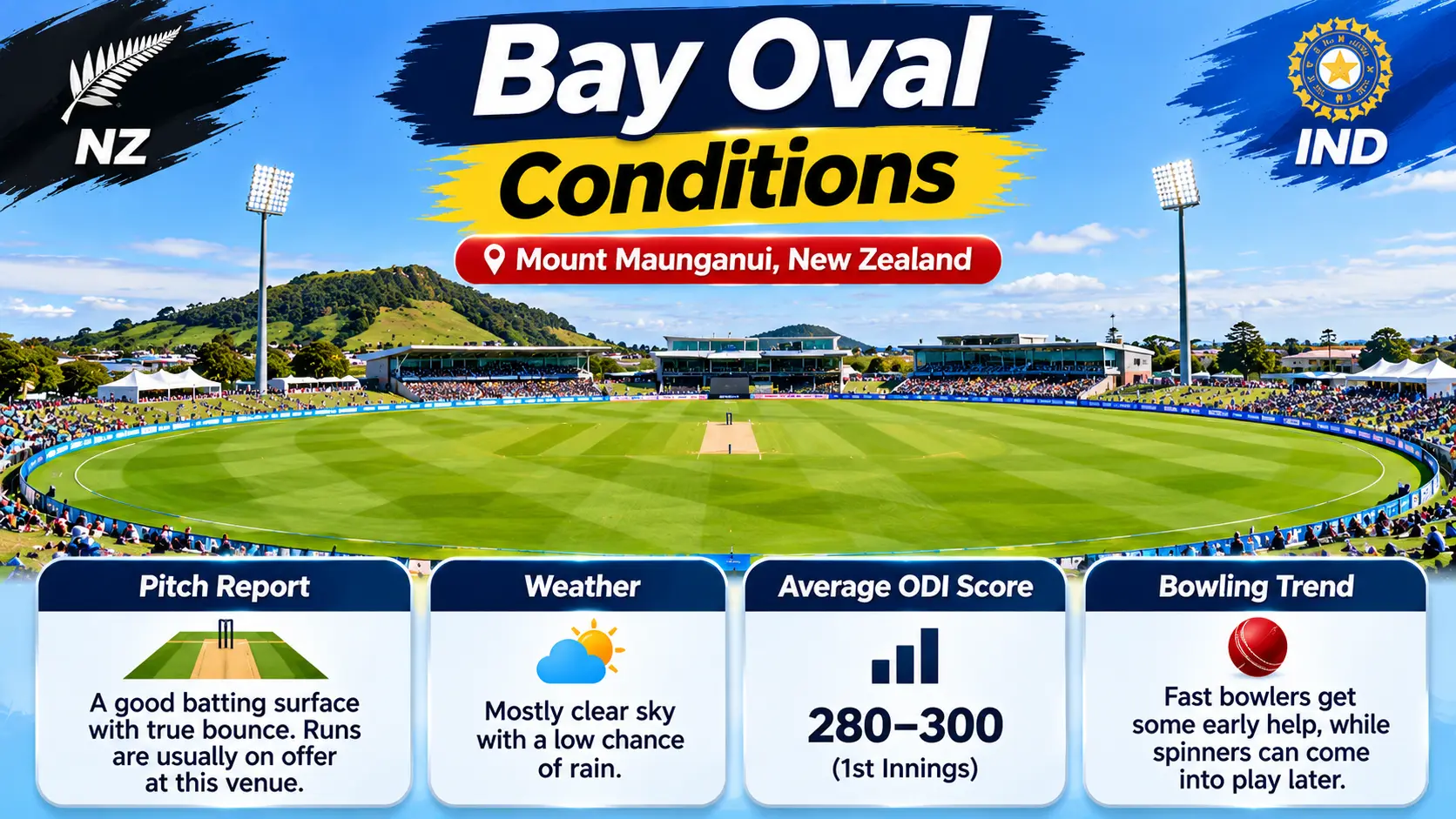
Both teams now know that Bay Oval can produce runs and sharp early bowling. Friday’s match began with a solid New Zealand powerplay and ended with a huge margin after India’s early collapse. That one result, however, does not prove every match on this ground will be the same. The fifth ODI may be played on a different strip, and the weather and moisture can change the first hour.
Batting first has appeal if the surface looks dry and even. A score near 280–300 would set up a genuine contest on a good strip, but that is a planning range rather than a guaranteed par score. If there is clear movement before the start, the captain winning the toss may prefer to bowl. The first few overs will be more useful than old venue averages when judging the actual pitch.
There is another reason to watch conditions: the third ODI was lost to weather, and rain already changed the first two results. A revised target can change the value of wickets and the ideal batting rate. Teams should be ready to alter their pace of scoring instead of assuming they will always have 50 overs.
NZ vs IND 5th ODI winning chances: who has the edge?

Our early editorial call is a near-even contest, with India just ahead. Their two victories and experienced batting group keep them marginally in front. New Zealand’s home advantage, Young’s form and Friday’s one-sided result pull the balance back. Henry’s and Jamieson’s absence is a meaningful reason not to make New Zealand a clear favourite despite the 244-run win.
India’s chance improves if the first wicket does not fall early, and if their attack can stop Young from playing another long innings. New Zealand’s chance grows if Duffy, Fisher and their pace partners reproduce the pressure Henry created on Friday. The prediction can change quickly after the playing XIs and pitch are confirmed.
How each team can win: the match-day decision plan
India’s winning route
Keep wickets intact in the opening ten overs. Allow Kohli or Iyer to bat through the middle phase. Use Axar to control scoring, and make sure the quicks are not exposed to repeated boundary overs. India do not need the perfect innings, only a connected one.
New Zealand’s winning route
Strike early without Henry. Let Young or another top-order batter control the innings while Seifert and Allen attack the shorter options. Santner must then use his bowling changes to keep India’s best batters from building a decisive partnership.
If the chase is shortened, the playbook changes. A batting side can no longer spend 20 overs quietly rebuilding. In that situation, a flexible middle order and batters who can find boundaries quickly become more valuable. The series has already shown why both captains need a second plan ready before the toss.
Probable playing XIs and selection watch
These are provisional selections, not confirmed teams. The Indian squad for the last two ODIs is led by Shreyas Iyer, with Ishan Kishan as vice-captain and wicketkeeper. New Zealand’s announced fifth-ODI squad includes Brett Randell and Josh Clarkson, but not Henry or Jamieson. There can still be changes based on fitness, conditions and the balance each side wants.
| India · possible XI | New Zealand · possible XI |
|---|---|
| Rohit Sharma | Tim Seifert (WK) |
| Ruturaj Gaikwad | Will Young |
| Virat Kohli | Finn Allen |
| Shreyas Iyer (C) | Nick Kelly |
| Ishan Kishan (WK, VC) | Dean Foxcroft |
| Tilak Varma | Michael Bracewell |
| Axar Patel | Mitchell Santner (C) |
| Auqib Nabi | Kristian Clarke |
| Mohammed Siraj | Matt Fisher |
| Arshdeep Singh | Jacob Duffy |
| Kuldeep Yadav | Blair Tickner |
India selection watch: Naman Dhir made 21 in the fourth ODI and remains a useful lower-middle-order option. He could be picked ahead of a specialist batter if the team wants greater bowling depth. Gurnoor Brar and Yash Thakur give India pace alternatives. Mohammed Siraj’s inclusion above is a projection, not a confirmed recall.
New Zealand selection watch: Matt Fisher’s three wickets make him a strong candidate to stay in the attack. Josh Clarkson offers another all-round option, while Brett Randell is a possible debutant. The hosts may choose one of them if the pitch calls for a different bowling balance.
Players to watch for fantasy cricket and match analysis
Player form is useful for both cricket followers and fantasy team research, but the best choice depends on the confirmed XI. Will Young comes in with the most eye-catching batting performance of the last match. Axar Patel has a different kind of value: his control with the ball, possible wickets and batting ability can matter even when he does not make a big score.
On India’s side, Kohli and Iyer remain major batting names, yet Friday is a reminder that reputation alone does not guarantee runs. A sensible pre-match watchlist also includes Ishan Kishan, who top-scored for India with 27, and Arshdeep Singh, who offers new-ball and late-innings bowling opportunities. For New Zealand, Duffy and Fisher deserve attention because they are available to lead an attack missing Henry.
If you follow player performances through Dream11 fantasy cricket, treat this as a match-form watchlist rather than a confirmed team or a guaranteed points forecast. Wait for the toss and check the current rules before making selections. No projection can remove the uncertainty of a single ODI.
Quick match-day checklist: Confirm both XIs; check whether the strip is fresh or previously used; watch the first four overs for movement; note who bowls the powerplay for New Zealand; and revise expectations if rain reduces the match.
Frequently asked questions
When is the NZ vs IND 5th ODI in 2026?
Sunday, 15 November 2026. Play is scheduled to begin at 7:30 AM IST, or 3:00 PM local New Zealand daylight time, at Bay Oval in Mount Maunganui.
What is the ODI series score before the fifth match?
India lead 2–1. India won the first two matches, the third ended without a result, and New Zealand won the fourth ODI by 244 runs.
Can the New Zealand vs India ODI series finish 2–2?
Yes. New Zealand must win the fifth ODI to level the five-match series 2–2. If India win or the game ends without a result, India take the series.
Will Matt Henry play the fifth ODI?
No. Matt Henry is not in the New Zealand Cricket squad announced for game five, and neither is Kyle Jamieson. New Zealand must choose a different pace combination.
Why did India lose the fourth ODI so heavily?
India lost Rohit Sharma, Virat Kohli and Shreyas Iyer for ducks in the first over, fell to 9/4, and were eventually dismissed for 89 while chasing 334. Matt Henry took 6/27.
Who has the best chance of winning the fifth ODI?
Our illustrative editorial forecast is India 48%, New Zealand 47%, and tie/no result 5%. It is not official odds or a statistically calibrated model, and it may change after the toss.
Final prediction: a contest decided by the opening ten overs
India’s 2–1 lead gives them the stronger series position, but New Zealand hold the momentum after a dominant fourth ODI. The crucial difference is that Henry and Jamieson will not be there to repeat Friday’s opening spell. That makes this finale a new tactical problem for both sides.
Final early call: India by the narrowest of margins, 48% to New Zealand’s 47%, with 5% reserved for a tie or no result. Watch the new ball, Young’s first partnership and the confirmed bowling combinations before taking the prediction further. The match is too close for a confident claim of an easy win.