

India and New Zealand drew the first Test of their 2026 series at Wellington’s Basin Reserve on 23 November. India piled up 720-9 declared after New Zealand made 368 in the first innings, but the hosts batted out the final day and reached 239/5 in 120 overs. India finished five wickets short of victory, despite taking a 352-run first-innings lead.
Innings Score Comparison
Runs scored in each innings • bars scaled against the highest total
NZ vs IND 1st Test 2026: Match Result and Scorecard
The five-day contest was played from 19 to 23 November 2026 at the Basin Reserve in Wellington. New Zealand won the toss and made 368 in their first innings. India responded with an enormous 720/9 declared, gaining a 352-run advantage. With the match moving into its final innings, the hosts needed to survive rather than chase the target, and they did so with disciplined batting and valuable partnerships.
| Innings | Score | Overs | Run rate |
|---|---|---|---|
| New Zealand 1st innings | 368 all out | 121 | 3.04 |
| India 1st innings | 720/9 declared | 166 | 4.34 |
| New Zealand 2nd innings | 239/5 | 120 | 1.99 |
| Match result | Drawn | ||
The margin between India’s first-innings total and New Zealand’s first-innings score was 352 runs. The final second-innings score left New Zealand 113 runs behind India’s declared total when the captains agreed to the draw. The result reflected the difference between India’s batting dominance and the difficulty of taking ten wickets on a surface that became increasingly favourable to batting.
Fans following the contest through Online Cricket ID can also keep an eye on key player performances and team combinations.
New Zealand’s First Innings: Nicholls and Phillips Rescue the Hosts

New Zealand’s first innings began under pressure. India struck early, and the hosts were reduced to a precarious position before Henry Nicholls and Glenn Phillips rebuilt the innings. Their sixth-wicket partnership of 216 runs transformed a vulnerable score into a competitive total and became one of the defining stands of the match.
Henry Nicholls’ composed 175 not out
Nicholls delivered the most substantial innings of the Test. His 175 not out came from 335 balls and included 21 fours. He managed the tempo carefully, resisted India’s attacking spells and remained at the crease long enough to turn the innings around. His innings was not simply about accumulation: it gave New Zealand time to recover from early wickets and allowed Phillips to play with greater freedom at the other end.
Nicholls’ patience was especially valuable on a pitch where early movement could challenge batters, but the conditions became less threatening as the game progressed. He repeatedly chose a low-risk option, kept the strike rotating and punished loose deliveries. His innings set up the draw by ensuring New Zealand had enough runs to make India work for a result.
Glenn Phillips’ 118 adds momentum
Phillips scored 118 from 216 balls, striking 14 fours. While Nicholls anchored the stand, Phillips provided a more assertive scoring option. The partnership’s 216 runs for the sixth wicket was the crucial recovery, taking New Zealand away from the danger zone and forcing India to spend a long period in the field.
| New Zealand batter | Runs | Balls | 4s | 6s |
|---|---|---|---|---|
| Henry Nicholls | 175* | 335 | 21 | 0 |
| Glenn Phillips | 118 | 216 | 14 | 0 |
| Rachin Ravindra | 15 | 50 | 2 | 0 |
| Nathan Smith | 14 | 44 | 2 | 0 |
| Kyle Jamieson | 11 | 21 | 1 | 0 |
| Tom Blundell | 5 | 22 | 0 | 0 |
| Jacob Duffy | 4 | 12 | 0 | 0 |
| Devon Conway | 4 | 13 | 0 | 0 |
| Daryl Mitchell | 1 | 8 | 0 | 0 |
| Tom Latham | 0 | 2 | 0 | 0 |
| Matt Henry | 1 | 9 | 0 | 0 |
India’s bowling response
Jasprit Bumrah was India’s most effective bowler in the first innings, taking 4/92 from 29 overs. Akash Deep claimed 3/53, while Anshul Kamboj took two wickets and Prasidh Krishna one. Bumrah’s early breakthroughs helped India place New Zealand under pressure, but the Nicholls–Phillips partnership meant the attack could not maintain control throughout the innings.
| India bowler | Overs | Runs | Wickets | Economy |
|---|---|---|---|---|
| Jasprit Bumrah | 29 | 92 | 4 | 3.20 |
| Akash Deep | 23 | 53 | 3 | 2.30 |
| Anshul Kamboj | 23 | 69 | 2 | 3.00 |
| Prasidh Krishna | 26 | 100 | 1 | 3.80 |
| Washington Sundar | 20 | 45 | 0 | 2.20 |
India’s 720/9 Declaration: A Massive Batting Statement
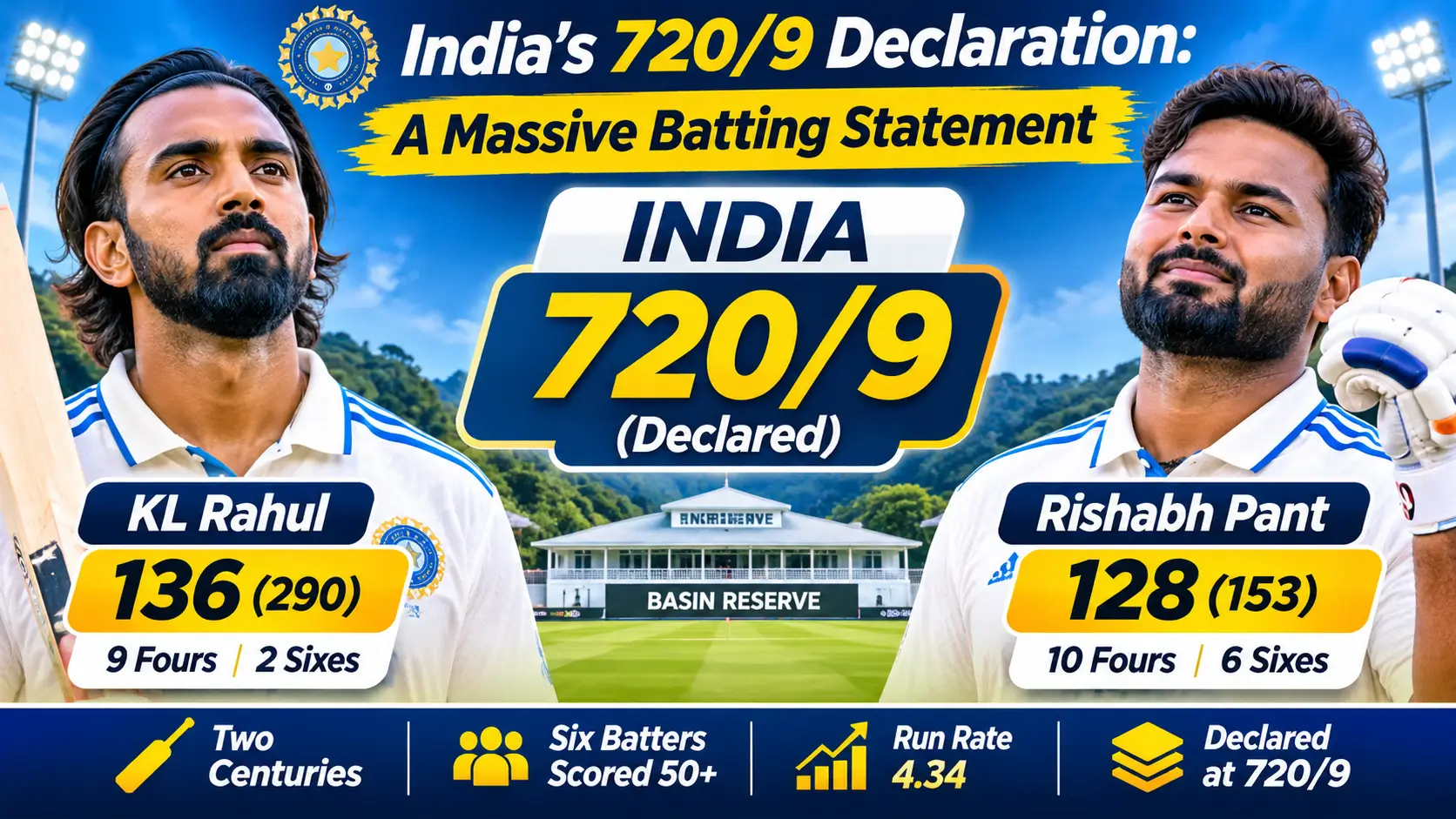
India’s first innings was the match’s biggest statistical headline. The team scored 720 runs in 166 overs at 4.34 runs per over and declared with nine wickets down. The innings featured two centuries, a near-century from captain Shubman Gill, and substantial contributions from the top and middle order. Six Indian batters reached at least fifty, giving the innings remarkable depth.
KL Rahul’s 136 provides the foundation
KL Rahul scored 136 from 290 balls, with nine fours and two sixes. His innings was built around concentration and judgement rather than rapid scoring. Rahul stayed long enough to provide the platform for India’s later acceleration and helped make the first-innings total possible. His partnership-building role was particularly important after India’s early positive start.
Rishabh Pant’s 128 changes the tempo
Pant’s 128 from 153 deliveries was a contrasting innings. He hit ten fours and six sixes, combining attacking intent with enough discipline to turn a strong position into a commanding one. His counterattack put pressure back on New Zealand’s bowlers and helped India increase the scoring rate without losing the innings’ structure.
Gill, Jaiswal, Padikkal and Jurel add major contributions
Yashasvi Jaiswal scored 85 from 89 balls, setting an energetic tone at the top. Devdutt Padikkal contributed 80 from 175 balls, while Shubman Gill made 98 from 146 deliveries—two runs short of a century. Dhruv Jurel added 78 from 79 balls, and Anshul Kamboj made a useful 38. These contributions meant New Zealand could not focus on one batter or one phase of the innings.
| India batter | Runs | Balls | 4s | 6s |
|---|---|---|---|---|
| KL Rahul | 136 | 290 | 9 | 2 |
| Rishabh Pant | 128 | 153 | 10 | 6 |
| Yashasvi Jaiswal | 85 | 89 | 16 | 0 |
| Devdutt Padikkal | 80 | 175 | 10 | 0 |
| Dhruv Jurel | 78 | 79 | 7 | 1 |
| Shubman Gill | 98 | 146 | 9 | 2 |
| Anshul Kamboj | 38 | 42 | 6 | 1 |
| Washington Sundar | 24 | 26 | 2 | 0 |
| Akash Deep | 13 | 5 | 0 | 2 |
| Jasprit Bumrah | 7* | 5 | 1 | 0 |
New Zealand’s bowling figures
Glenn Phillips was New Zealand’s leading wicket-taker, finishing with 3/154. Rachin Ravindra took two wickets, while Matt Henry, Kyle Jamieson, Jacob Duffy and Nathan Smith each claimed one. The workload was heavy, particularly for the seamers, and India’s long innings reduced the time available for a fourth-innings chase or sustained wicket-taking attempt.
Top Individual Scores
Selected top innings from the Test • runs
Day-by-Day Highlights: How the Test Developed
Day 1: New Zealand start, India strike
India made early inroads into New Zealand’s batting, putting the hosts under pressure in the opening session. Bumrah’s movement and control were central to the early wickets, while India’s seamers maintained disciplined lines. New Zealand’s recovery was incomplete at stumps, but the resistance from the middle order kept the innings alive.
Day 2: Nicholls and Phillips rebuild; India begin their reply
The major story of New Zealand’s innings was the 216-run stand between Nicholls and Phillips. Their partnership lifted the total to 368, giving the hosts a more respectable first-innings score. India began their response with a positive approach and established the early foundation for a long batting innings.
Day 3: India move into control
India’s top order accumulated runs and made the match increasingly difficult for New Zealand. Rahul and the batters around him helped push the total forward, while the team’s lead began to grow. The innings was notable for the combination of patient batting and scoring opportunities, with India keeping wickets in hand.
Day 4: Pant’s century and declaration pressure
Pant’s century was one of the standout moments. His 128 helped India reach 720/9 declared, a total that gave the visitors a 352-run lead. The declaration placed New Zealand in a defensive position: the hosts needed to bat for a substantial period simply to avoid defeat. India made an early breakthrough in the second innings, but New Zealand’s batters began to show the resistance required.
Day 5: New Zealand survive to draw
India entered the final day needing eight wickets. New Zealand’s second innings, however, became a long defensive effort. Devon Conway scored 65, while Daryl Mitchell and Glenn Phillips helped occupy the crease late in the day. India took five wickets, but the remaining batters and time ran out before the visitors could finish the job. New Zealand closed on 239/5 from 120 overs, and the match was drawn.
New Zealand’s Second Innings: A Determined Final-Day Resistance
The fourth innings was a test of patience and survival rather than run-chasing. New Zealand were behind by 352 runs after the first innings, so the realistic objective was to bat time and protect wickets. India’s early breakthrough gave the visitors a chance, but the hosts kept the innings moving carefully.
Conway’s 65 anchors the innings
Devon Conway made 65 from 165 balls. His innings was a crucial contribution because it absorbed pressure and gave the middle order a platform. New Zealand lost wickets during the innings, but Conway’s time at the crease made it harder for India to maintain a constant attacking field and create chances.
Mitchell and Phillips shut the door
Daryl Mitchell remained unbeaten on 49 from 186 balls, while Glenn Phillips finished 26 not out from 126 deliveries. Their sixth-wicket stand of 63 was not built around quick runs. It was a time-consuming partnership that reduced India’s remaining opportunity to take wickets. Their defensive discipline and shot selection were the defining tactical features of the closing session.
| New Zealand 2nd innings | Runs | Balls |
|---|---|---|
| Devon Conway | 65 | 165 |
| Henry Nicholls | 31 | 59 |
| Rachin Ravindra | 37 | 129 |
| Daryl Mitchell | 49* | 186 |
| Glenn Phillips | 26* | 126 |
| Tom Blundell | 15 | 54 |
| Tom Latham | 0 | 2 |
| Total | 239/5 | 120 overs |
India’s second-innings bowling figures included Prasidh Krishna’s 2/23 from 19 overs. Washington Sundar, Jasprit Bumrah and Anshul Kamboj also took wickets. The visitors were able to make breakthroughs, but the surface and the remaining time made a complete dismissal increasingly difficult.
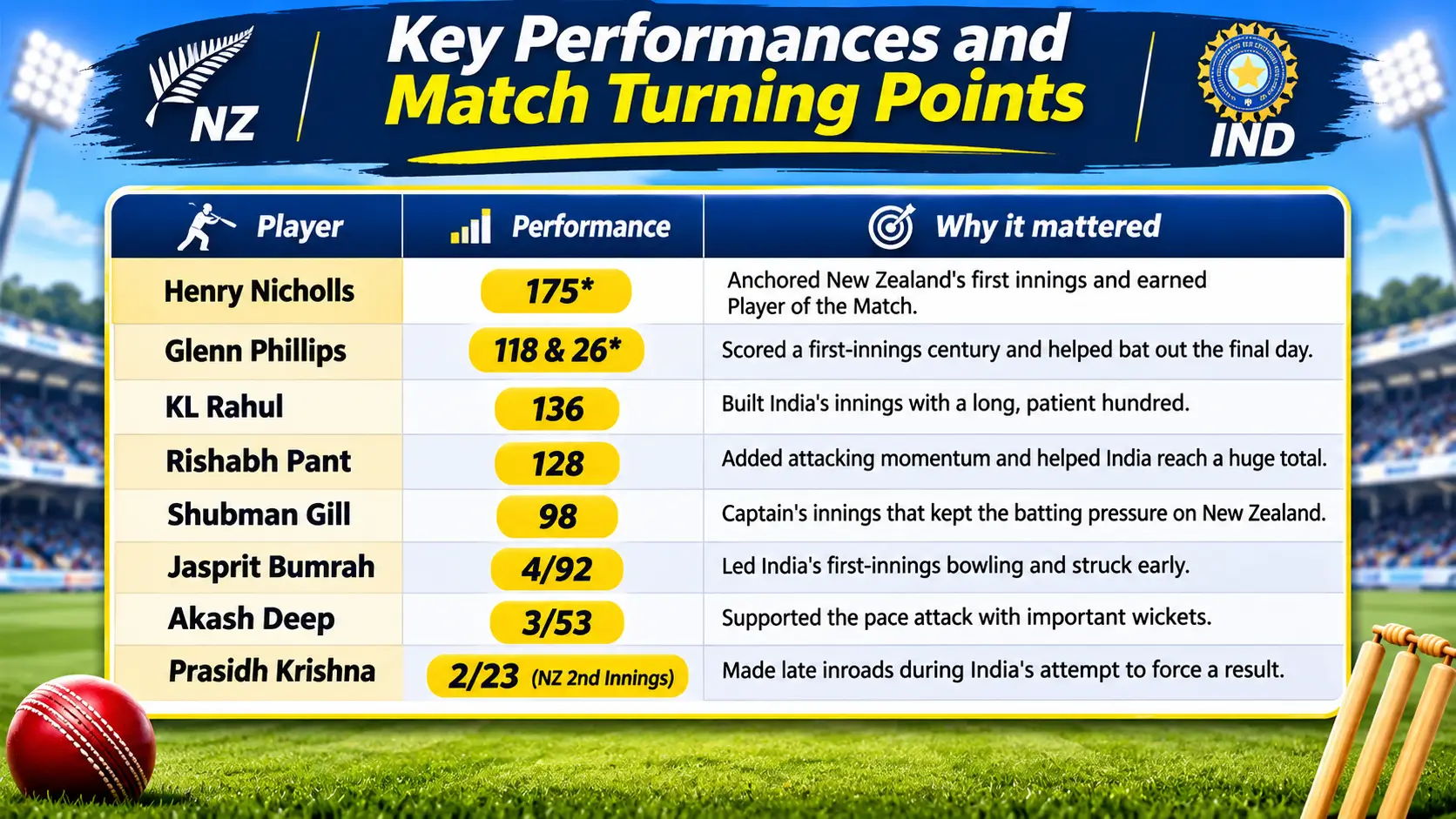
Key Performances and Match Turning Points
| Player | Performance | Why it mattered |
|---|---|---|
| Henry Nicholls | 175* | Anchored New Zealand’s first innings and earned Player of the Match |
| Glenn Phillips | 118 & 26* | Scored a first-innings century and helped bat out the final day |
| KL Rahul | 136 | Built India’s innings with a long, patient hundred |
| Rishabh Pant | 128 | Added attacking momentum and helped India reach a huge total |
| Shubman Gill | 98 | Captain’s innings that kept the batting pressure on New Zealand |
| Jasprit Bumrah | 4/92 | Led India’s first-innings bowling and struck early |
| Akash Deep | 3/53 | Supported the pace attack with important wickets |
| Prasidh Krishna | 2/23 in NZ 2nd innings | Made late inroads during India’s attempt to force a result |
Turning point 1: The 216-run Nicholls–Phillips stand
New Zealand’s recovery partnership changed the outlook of the first innings. Without it, the hosts risked being dismissed for a substantially lower score. The stand forced India to use more overs and helped protect the lower order from immediate pressure.
Turning point 2: India’s deep batting contribution
India’s 720/9 was built through multiple substantial innings rather than one individual score. The top five all made at least 80, an unusual collective contribution that kept New Zealand’s bowlers working across long spells. The declaration created a huge lead, but it also meant India had to plan carefully for the remaining time.
Turning point 3: New Zealand’s final-day batting plan
Conway, Mitchell and Phillips focused on occupation of the crease. They did not attempt to turn the game into a scoring contest. Their approach limited risk, made India’s fielders work and steadily reduced the available time. This was the most direct reason the match ended in a draw.
Tactical Analysis: Why India Could Not Convert the Lead into a Win
India’s batting performance was dominant, and a 352-run first-innings lead normally provides a strong platform to push for victory. The challenge was the combination of time, pitch conditions and New Zealand’s defensive batting. A large total is not automatically decisive in Test cricket when the surface becomes easier and the fourth innings has enough time to bat out.
India’s declaration at 720/9 gave the bowlers an opportunity, but the innings consumed 166 overs. The team then needed to dismiss New Zealand twice within the remaining match time. The first innings lasted 121 overs, and the second innings required 120 overs for five wickets. That workload underlined the lack of sustained assistance for the bowling attack later in the game.
New Zealand’s tactical response was straightforward but demanding: minimise mistakes, avoid high-risk scoring options and make India’s bowlers earn each wicket. Mitchell and Phillips demonstrated how a fourth-innings partnership can be valuable even when it produces a modest run rate. In a match situation where time is the opponent, every over survived matters.
India can take positives from the batting depth and the bowlers’ early impact. However, the result also highlights the importance of creating enough pressure through fields, bowling changes and attacking lengths when a draw becomes the primary threat. The match was not lost; India simply ran out of time to complete the win.
What the Draw Means Ahead of the Second Test
The draw leaves the two-match series level at 0–0 and shifts attention to the second Test in Christchurch, scheduled to begin on 27 November 2026. India will take confidence from the substantial batting performances, especially Rahul and Pant’s hundreds, and from Bumrah’s first-innings impact. New Zealand will take encouragement from the ability of Nicholls, Phillips and the final-innings batters to withstand pressure for long periods.
For India, the next match may require sharper time management if conditions again favour batting. For New Zealand, the challenge is to turn the resilience shown in Wellington into a more competitive all-round performance, particularly with the ball. The drawn opener has made the next Test important to the series result.
Official tour squad information and announcements can be checked through the BCCI’s India squad announcement for the New Zealand tour.
IND vs NZ 1st Test 2026: Frequently Asked Questions
Who won the IND vs NZ 1st Test in 2026?
The first Test between India and New Zealand ended in a draw at Wellington’s Basin Reserve on 23 November 2026. India were five wickets short of victory when the match ended.
What was the final score of the India vs New Zealand Test?
New Zealand scored 368 in the first innings, India declared at 720/9, and New Zealand finished their second innings at 239/5 in 120 overs.
Who was Player of the Match?
Henry Nicholls received the Player of the Match award after scoring an unbeaten 175 in New Zealand’s first innings.
How many runs did KL Rahul score?
KL Rahul scored 136 from 290 balls, including nine fours and two sixes, in India’s first innings.
How many runs did Rishabh Pant score?
Rishabh Pant made 128 from 153 deliveries, hitting ten fours and six sixes in India’s innings of 720/9 declared.
Why did India not win despite a 352-run lead?
India’s large lead was not enough because New Zealand batted for 120 overs in the second innings and finished 239/5. The pitch offered limited assistance as the match progressed, and time ran out before India could take five more wickets.
Conclusion
The IND vs NZ 1st Test Highlights tell the story of a match with two contrasting strengths: India’s commanding batting and New Zealand’s resilience. India posted 720/9 declared, with Rahul, Pant, Gill, Jaiswal, Padikkal and Jurel making substantial contributions. New Zealand’s first-innings recovery was led by Nicholls and Phillips, while Conway, Mitchell and Phillips helped secure the draw on the final day.
The result leaves the series open and gives both teams lessons to take into the next Test. India will look to convert dominance into a result, while New Zealand can build on a disciplined performance under pressure. Wellington delivered a memorable batting contest—and a reminder that in Test cricket, a match can be saved through patience, partnerships and time management.